
 Image 1 of 1
Juglans regia, most frequently referred to as the common walnut, English walnut, or Persian walnut, is a large, long-lived deciduous tree species prized globally for its highly nutritious edible nuts and premium fine-grained timber. Native to a broad region spanning from Southeast Europe across Central Asia to the Himalayas, it is one of the oldest known food sources and has been systematically cultivated by humans for thousands of years. A wind-pollinated, monoecious species. Drooping green male catkins open in mid-to-late spring, followed several weeks later by small, spiking female flowers. An interesting fact: the roots, fallen leaves, and husks release a biochemical compound called juglone into the surrounding soil. Juglone serves as a natural herbicide, severely restricting or preventing the growth of many other plant species directly underneath the tree's canopy.
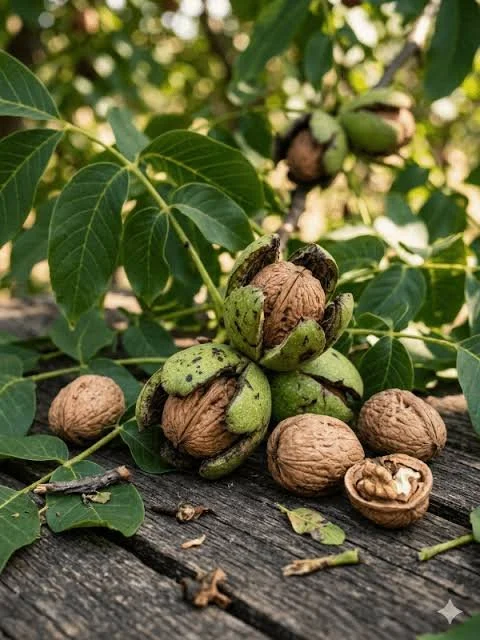
Fruit Colour: Wrinkled, hard-shelled stone seed, encased within a thick, smooth, green fleshy husk.
Fruit Shape: Globose to broadly ovoid (round to slightly oval) in shape.
Fruit Size: Resembles a small plum, 3.5 to 5 cm long and 3 to 4 cm wide.
Flavour: Rich, mild, and distinctly buttery flavor profile with a delicate balance of sweetness and subtle earthiness.
Fruit Season: During autumn, the green outer husks split open to release the mature nuts onto the ground.
Cropping Habit: Most backyard and commercial trees are grafted and typically produce a light crop within 3 to 5 years after planting.
Best Uses: High-value agriculture (nut, raw or roasted; baking sweet or savoury; walnut oil); luxury woodworking for furniture, gun stocks & tool handles; traditional medicine; and environmental landscaping like shade tree or windbreak.
Light requirement: Full sun
Water requirement: High, demanding consistent, deep moisture throughout the growing season
Watering frequency: High, demanding consistent, deep moisture throughout the growing season
Soil: Demands deep, rich, well-drained loamy soils to maximize nut production.
Skill level: Beginner
Growth rate: Moderate
Suitable for container gardens: Highly unsuitable for long-term container gardening and will eventually fail if kept in a pot permanently.
Mature Height: 15 to 25m
Mature Width: 12-18m
Seasonality: Deciduous
Drought Tolerant: Moderate
Frost Tolerant: It is highly frost-tolerant once established.
Wind Tolerant: Moderate
Leaf colour: Spring: Bronze, copper, or reddish-brown tint. Summer: bright green to deep matte green. Autumn: clear golden-yellow to greenish-yellow.
Leaf Variegation pattern: No
Size of leaf: 25 to 40cm in total length.